Marrakech is where most journeys through Morocco begin, and where many of our guests choose to end theirs. The Red City mixes a thousand-year-old medina with some of the finest riads and restaurants in North Africa. Here are the experiences we recommend most often to our private guests, with the practical details that make each one easier to enjoy.
At a glance. Best months: March–May and September–November · Ideal stay: 3 nights · Currency: Moroccan dirham (MAD) · Getting around: on foot in the medina, private car beyond it.
1. Jemaa el-Fna Square

Jemaa el-Fna is the beating heart of Marrakech and a UNESCO-listed “masterpiece of oral heritage”. By day you will find orange-juice sellers, henna artists and musicians; as the light fades, dozens of open-air food stalls appear and the square fills with smoke, drums and storytellers. For the best view, take a mint tea on one of the rooftop terraces around the square at sunset, then walk down once the stalls are lit.
Tip: keep a few small coins for performers you photograph, and politely decline anyone who offers to “show you the way” – your guide will.
2. The Medina and its Souks

North of the square, the medina’s covered souks are organised by craft: leather in one alley, lanterns in the next, spices, carpets and the dyers’ souk with skeins of wool drying overhead. It is a maze, and that is part of the pleasure. With a private local guide you can go straight to the best workshops, see artisans at work and shop without pressure. Bargaining is expected – start at around half the first price and enjoy the conversation.
3. Stay in a Luxury Riad

A riad is a traditional house built around an inner courtyard, often with a fountain, orange trees and a plunge pool. Behind a plain door in a quiet lane you step into a world of carved cedar, zellige tiles and rooftop terraces. Staying in one is an experience in itself: breakfast in the courtyard, a hammam in the afternoon and dinner under the stars. In our Premium and VIP packages we select riads and palace hotels we know personally, so every room meets the same standard.
4. The Koutoubia Mosque

The 12th-century Koutoubia is the largest mosque in Marrakech, and its 77-metre minaret is the city’s landmark – no building in the medina may be taller. The mosque is open to Muslims only, but its rose gardens are a peaceful place for a walk, especially early in the morning or when the call to prayer echoes across the city at dusk.
5. Jardin Majorelle

Created by the painter Jacques Majorelle in the 1920s and later restored by Yves Saint Laurent and Pierre Bergé, the garden is famous for its intense “Majorelle blue”, cactus collection and bamboo groves. Next door, the Musée Yves Saint Laurent celebrates the designer’s love of Marrakech. Tickets are timed and sell out in high season, so we book them for you in advance and suggest visiting at opening time.
6. Bahia Palace

Built in the late 19th century for the grand vizier Ba Ahmed, the Bahia Palace is a showcase of Moroccan craftsmanship: painted cedar ceilings, carved stucco, marble courtyards and gardens of orange and banana trees. Combine it with the nearby Saadian Tombs and the ruins of El Badi Palace for a half-day in the southern medina.
7. Moroccan Cuisine, from Street Food to Fine Dining

Marrakech is one of the best places in Morocco to eat. Try a slow-cooked tagine, a sweet-and-savoury pastilla, tangia (the city’s own slow-cooked beef, traditionally baked in the embers of a hammam furnace) and fresh mint tea. In the evening, the city offers everything from the food stalls of Jemaa el-Fna to elegant riad restaurants and rooftop dining with views of the Atlas.
8. A Private Cooking Class
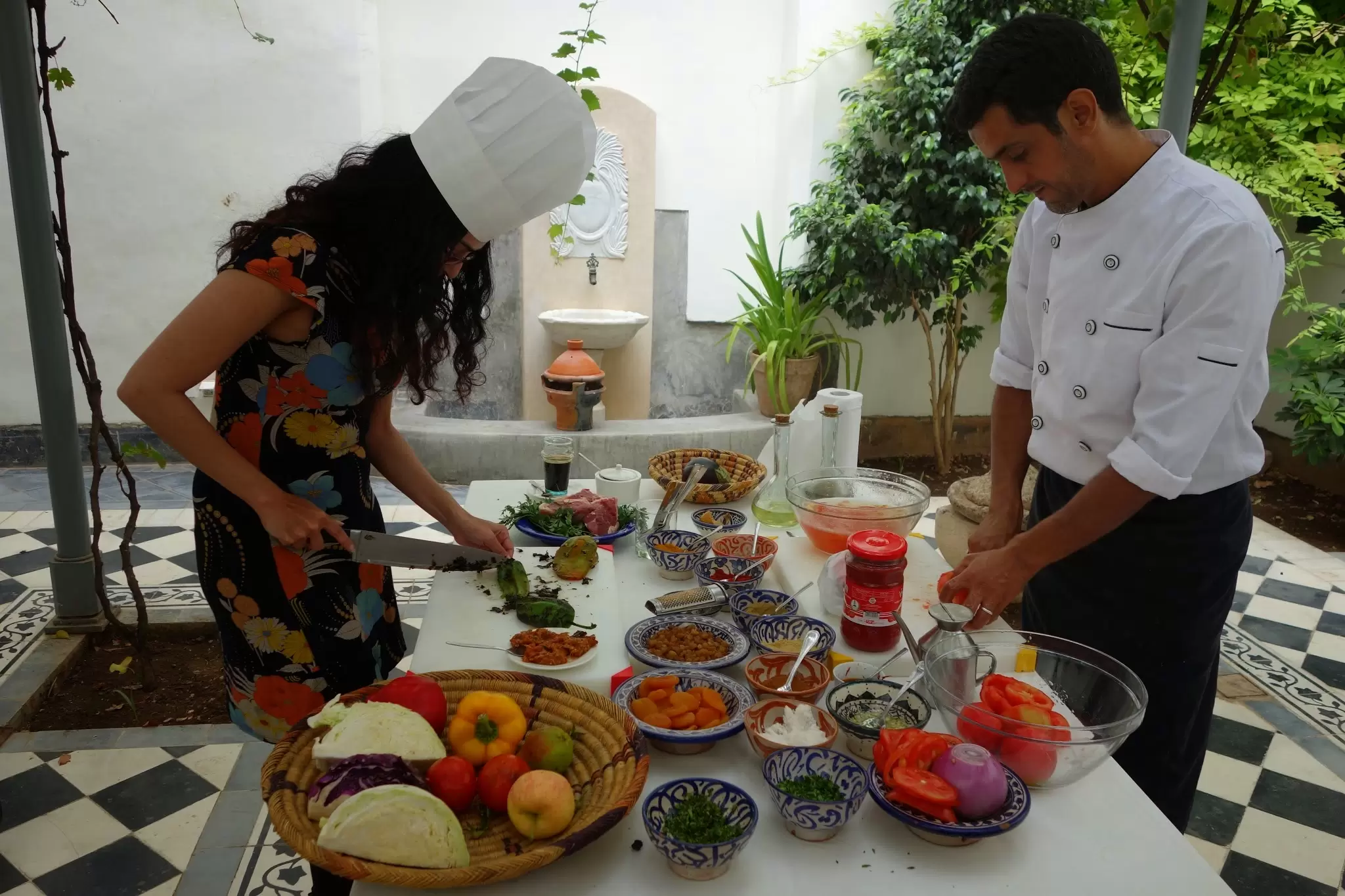
The best way to understand Moroccan food is to cook it. A private class usually starts with a walk through the market with your chef to choose spices and vegetables, then continues in a riad kitchen where you prepare salads, a tagine and bread before sitting down to eat what you made. The cooking class is included in our VIP All-Inclusive package and can be added to any other journey.
9. A Hot-Air Balloon Flight at Sunrise

About 40 minutes from the city, balloons lift off at dawn over the Agafay plains and Berber villages, with the snow-capped High Atlas on the horizon. Flights last around an hour and end with a traditional breakfast in a Berber tent. The hot-air balloon is included in our VIP All-Inclusive package; for other packages we are happy to reserve it for you.
More Experiences Worth Your Time
Ben Youssef Madrasa and Le Jardin Secret
The 16th-century Ben Youssef Madrasa, once the largest Koranic school in North Africa, has one of the most beautiful courtyards in Morocco, with carved cedar, stucco and a central pool. A few minutes away, Le Jardin Secret is a restored riad garden with Islamic and exotic sections – a quiet escape in the middle of the medina.
The Saadian Tombs and El Badi Palace
Rediscovered in 1917, the Saadian Tombs hold the sultans of the Saadian dynasty beneath intricate marble and cedar domes. Nearby, the vast ruins of El Badi Palace give a sense of the city’s 16th-century splendour, and its walls are home to dozens of storks’ nests – climb to the terrace for a view over the medina.
A Traditional Hammam
The hammam is part of everyday Moroccan life. In a luxury riad or spa, the ritual includes a steam room, a black-soap scrub with a kessa glove, a clay or rhassoul wrap and a massage with argan oil. It is the perfect way to recover after a day in the souks, and many of the riads we use have their own hammam.
Sunset in the Agafay Desert
Less than an hour from the city, the stony Agafay desert offers wide open views of the Atlas Mountains. Ride a camel or a buggy in the late afternoon, then stay for dinner under the stars in a luxury camp. It is a lovely taste of the desert if your time is short, although nothing replaces the great dunes of the Sahara at Merzouga.
A Day in the Atlas Mountains
Within an hour of Marrakech, the High Atlas valleys of Imlil and Ourika offer cool air, walnut groves and Berber villages. An easy guided walk followed by lunch with a Berber family is one of the most authentic days you can spend in Morocco – it is included in our Imperial Cities and 12-day tours.
Where to Stay in Marrakech
In the medina, a riad puts you within walking distance of the souks, palaces and Jemaa el-Fna, with the charm of a traditional house. In the Hivernage and the Palmeraie, palace hotels and resorts offer large gardens, pools and spas, a short drive from the old city. Many of our guests combine both: a riad for the first nights, then a resort to relax at the end of the journey. Our Premium, VIP and Ultra VIP packages differ mainly in the level of these stays.
Plan Marrakech privately
Marrakech features in almost all of our journeys. Spend three nights here at the end of our 8-day imperial cities and Sahara tour, combine it with Fes and Rabat on our Imperial Cities tour, or add a day in the Atlas villages on our 11-day tour. Short on time? Our 7-day tour pairs Marrakech with two nights in the Sahara. Tell us your dates – we reply the same day, often within an hour.
Practical Tips for Marrakech
- Dress: light, loose clothes that cover shoulders and knees are comfortable in the heat and respectful in the medina. A scarf is useful for women and for sun protection.
- Money: card payment is accepted in hotels and most restaurants; carry dirhams for the souks, taxis and tips. ATMs are easy to find.
- Water: drink bottled water; it is provided in your car throughout our tours.
- Getting around: the medina is best explored on foot; your private driver takes you to the gardens, the palmeraie and beyond.
- Friday: some sites and shops close around midday prayers on Friday – your guide plans around them.
Frequently Asked Questions
When is the best time to visit Marrakech?
Spring (March to May) and autumn (September to November) are ideal, with daytime temperatures of around 20–30 °C. Summer can exceed 40 °C, while winter days are mild and sunny but nights are cold – a lovely time if you enjoy a fire in your riad.
How many days should I spend in Marrakech?
Three nights is ideal: one day for the medina and souks with a guide, one for the gardens, palaces and food, and one for a day trip to the Atlas Mountains or the Agafay desert. Add a night if you would like time to relax in your riad.
Do I need a guide to explore the souks?
You can explore alone, but a licensed local guide saves a lot of time, takes you to the best artisans and explains the history behind what you see. All our tours include a private certified guide for the Marrakech medina.
Is Marrakech safe for travellers?
Yes. Marrakech is a welcoming city and very used to visitors. As in any busy city, keep an eye on your belongings in crowded places and use official guides and taxis. With a private driver and guide, you are looked after from arrival to departure.
What is the local currency, and should I carry cash?
The currency is the Moroccan dirham (MAD). Cards are widely accepted in hotels and restaurants, but cash is preferred in the souks and small cafés, so withdraw some dirhams at an ATM on arrival.
Continue reading: the best places to visit in Morocco and the best luxury desert camps in Merzouga.
More guides: the best day trips from Marrakech, the best luxury hotels and riads in Morocco and 12 unique experiences in Morocco.